Malcolm Gladwell, The American Way of Killing: The Invention of an Epidemic. Little, Brown, 2026. Read in October 2026.
I have a complicated relationship with Malcolm Gladwell’s work. Fascinating in places, very banal in others, often rather taken with itself, and trailed by accusations of being too cosy with the tobacco lobby.
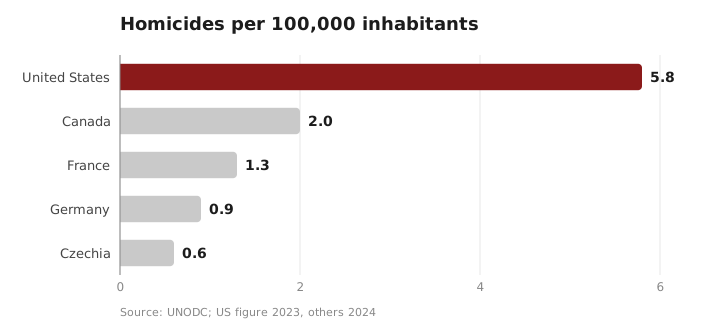
The American Way of Killing, though, is good. Its premise is simple: why is there so much more violence in America (5.8 homicides per 100,000 people a year, against 2 in Canada, 0.9 in Germany and 0.6 in the Czech Republic)? Does that mean there is more crime in general (not really)? Is it getting better or worse? (Better: in 2025 the number of murders fell by 18% to 4.1 per 100,000, the lowest since 1956.) What are the underlying forces, and what does the Second Amendment actually mean? Gladwell’s answer is simple at its core: lots of guns (120 per hundred people, so more guns than people), lots of freedom, not enough police, and weak social ties. Conflicts escalate fast, and when a gun is within reach, they end in death.
As he works through the individual problems of both the debate and the reality, he cuts fairly evenly in both directions. A ban on “assault rifles” sounds like a plausible idea - until you look at the statistics on deaths per hit and per incident, and suddenly it appears that smaller handguns are considerably more lethal: of gun murders where the weapon type is known, 53% involve a handgun and 3% a rifle, and Braga and Cook’s Boston data show that what decides survival is mainly calibre - a large-calibre wound is nearly five times as likely to kill as a small-calibre one. At the same time, the proposed assault-weapon bans contain so many exemptions, permitted items, plain technical errors and prohibitions of functional accessories that solve nothing whatsoever, that the conclusion all but writes itself: maybe this isn’t a dispute about safety at all, maybe the whole thing is security theatre.
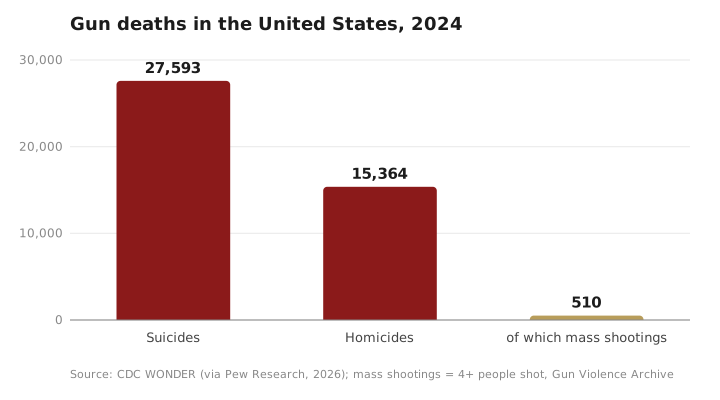
Public debate likewise clings to the relatively falling number of deaths (because doctors keep getting much better: the lethality of assaults in the US has fallen by 2.5–4.5% a year since the 1960s, mainly thanks to trauma care, and today for every person shot dead nearly two are shot and survive), and to mass shootings, which are of course horrific and still an essentially uniquely American phenomenon, but which are dwarfed in body count by ordinary petty crime and emotional disputes that get out of hand (in 2024, mass shootings killed 510 people out of 15,364 gun homicides). And all of those pale next to the number of suicides by firearm: 27,593 in 2024, an all-time high and 62% of all gun deaths.
Here, admittedly, it is ethically more complicated whether this is necessarily a problem, since almost anything can be used for suicide. In purely utilitarian terms, though, a gun is very convenient to use and extremely close at hand. As someone who has wrestled with dark thoughts and has an unsuccessful attempt behind him from many years ago, I can say that if I had had a pistol available, it might have turned out differently.
For the (mostly American) debate he also has counterintuitive but statistically grounded evidence: defunding the police is already happening in practice. The US has too few officers, working in bad conditions. There are roughly 225 per 100,000 inhabitants against an EU average of 342, and 30,000 fewer in total than in 2017; 61% of murders get solved. That sharply raises the risk of accidents and failures, and it creates a problem of principle: if you cannot maintain overall presence, do long-term work, heaven forbid get involved in the life of communities or simply be visible on the street, the answer becomes more brutality. Wanting to cut funding in response to police violence is thus a rather senseless move. What is worth talking about instead is how American prisons operate, who ends up in them, what their life prospects are afterwards, and what running them costs (the US imprisons 542 people per 100,000; the Czech Republic 179, Germany 71, Norway 54).
The deeper dive into why the Second Amendment exists at all and what it was originally meant to address (tl;dr: the right to militias, which were essential to the heavily slaveholding states) is linguistically and legally interesting (more than that I can’t judge) and historically well built. It is also, in some way, the weakest part of the book’s argument. Yes, the right named in the Second Amendment was written and worded with very different intentions than the ones it serves today. But over at least the last century it has acquired a new interpretation and meaning of its own, legal and political: it would surely deserve a rewrite (which is technically more or less impossible), but if judges and legislators keep affirming “this is about your personal right to carry a gun” and keep winning political support for it, then the origin and the wording of the original document don’t matter at all. Gotcha, fine, Madison made a compromise to hold on to the votes from Virginia. A lot of water has flowed under the bridge since then, along with a lot of opportunities to change it, and it has stayed this way, consequences included.
Overall, though, The American Way of Killing can be recommended without reservation. The anecdotal and affecting stories are kept to a bearable dose and work as illustration; the book offers a coherent view of a specific problem, and it is very transparent about what it wants to solve: why people kill each other so much and how that could be reduced - without endlessly repeating “ban guns”. More money for the police, a different prison system, or targeted training in handling emotions for young people don’t force anyone to give up their perceived rights and freedoms.
America may, after all, quite well decide that it is content with this unique feature of itself and that it is worth the price. Clearing the nonsense and the distractions out of the debate can only help it make that decision.
Sources for the figures: CDC WONDER (via Pew Research, April 2026), FBI Crime in the Nation 2025 and FBI Crime Data Explorer, UNODC, Small Arms Survey 2017, Council on Criminal Justice: Policing by the Numbers (2026), Eurostat, World Prison Brief, Gun Violence Archive, Braga & Cook, JAMA Network Open 2018, Harris et al., Homicide Studies 2002.