Hannah Ritchie, a data scientist at Our World in Data, published her second climate book in 2025 — Clearing the Air: A Hopeful Guide to Solving Climate Change — in 50 Questions and Answers. The format tells you the essentials: fifty questions people actually want answered (“Isn’t it already too late?”, “Are we going to run out of minerals?”, “Do heat pumps actually work?”), and short, data-backed answers. Threading them together is a constant reliance on widely available data and a baseline insistence on solid evidence — combined with a certain hope in humanity. The first part is excellent. The second part is too — but it calls for a bit of caution and context.
Who it’s for
The primary audience is people with little or no orientation in climate matters who want a decent starting point that won’t bury them in either panic or technical jargon. Ritchie writes cleanly, briefly, and without straying into tangents and depths that are useful for very technical debate but pointless in an overview. But I think it actually works just as well, maybe even better, for people who have spent some time around energy and decarbonisation: she has perspective and presents enough information without constantly needing to position herself.
What the book does very well
Renewables and nuclear as complements, not enemies. This debate tends to be tribal in Czechia — A vs. B. Ritchie treats both technologies on the merits, as tools that solve different parts of the problem (variability vs. baseload, deployment speed vs. stability, land area vs. capital cost). She also touches lightly on why we’re no stars at building nuclear plants in the West anymore, and why it works elsewhere. She skips the question of how much exactly nuclear should make up of the energy mix, but it clearly has some place in it.
Explaining coal’s role in China. This is the topic where everyday debate breaks down hardest. Ritchie presents it so that a reader understands how China’s gigantic coal emissions and China’s gigantic investments into solar and batteries are part of the same story — industrial strategy, energy security, and political nervousness about supply disruptions. For context: in 2024 alone, China built 94.5 GW of new coal capacity (ninety-three percent of all coal construction worldwide) — and at the same time added 277 GW of solar and 79 GW of wind. Both at once. And much of that coal isn’t expected to run continuously: it’ll be switched on as actual demand requires.
A tone of “it’s possible” rather than “we’re cooked.” Ritchie doesn’t pretend the transition will be easy or cheap. But she rejects doomerism as analytically wrong and shows that for a large part of the “unsolvable problems” the answer is along the lines of “yes, it’s hard, but better than the alternative” — yes, looking at wind turbines obviously isn’t ideal. The impacts of burning fossil fuels, however, don’t just hit the climate; they’re slowly killing people who simply have to breathe the result.
A nice illustration that you don’t see often enough in public discourse is just how much renewables actually cost, and how the trend has moved.
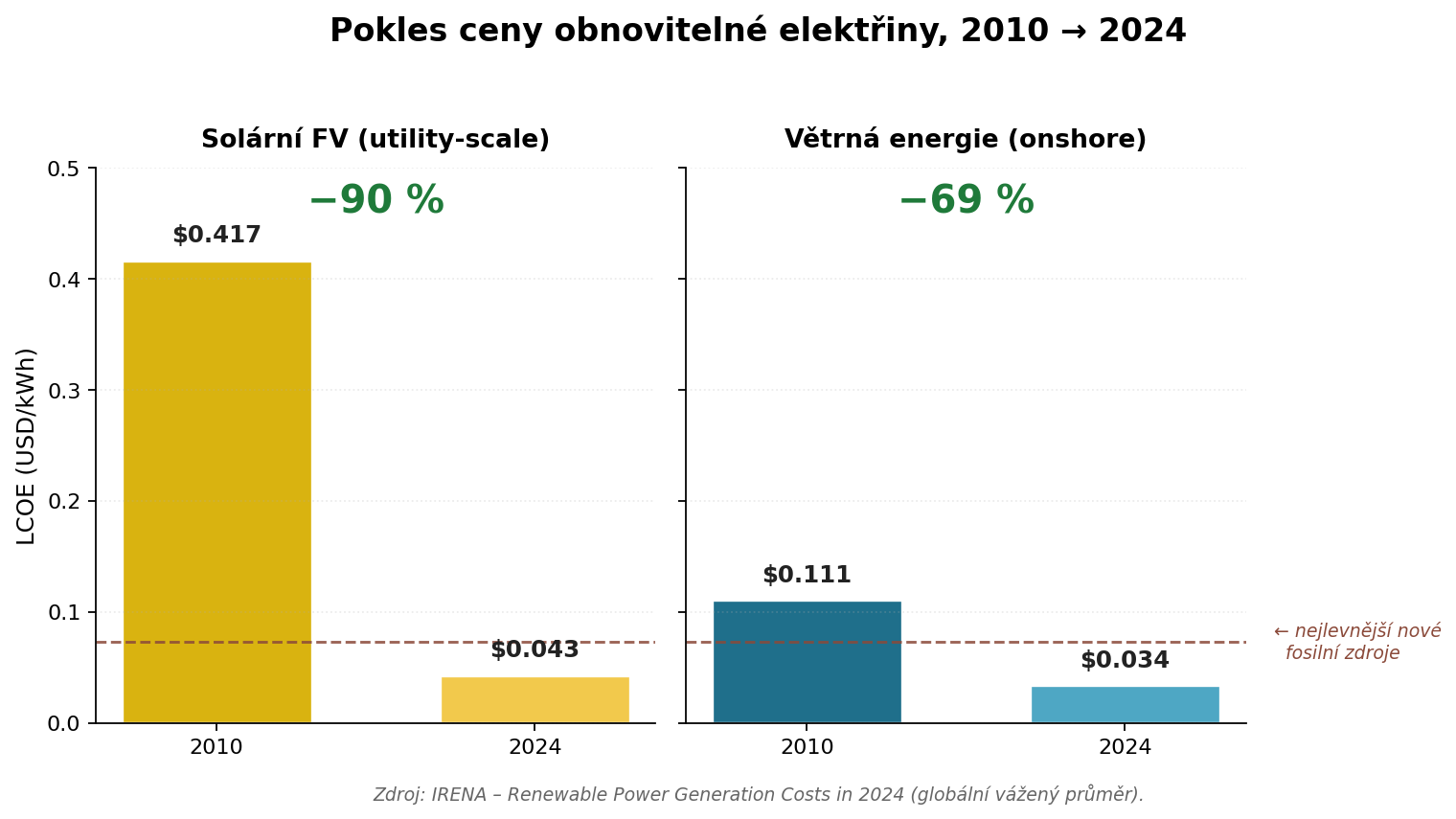
A few numbers for the record:
- Utility-scale solar PV fell from $0.417/kWh in 2010 to $0.043/kWh in 2024 — a 90 % decline.
- Onshore wind dropped from ~$0.113 to $0.034/kWh (a 70 % decline) — 53 % cheaper than the cheapest fossil alternative.
- Battery storage has fallen 93 % since 2010, to today’s $192/kWh.
- In 2024, 91 % of all newly commissioned renewable projects delivered electricity more cheaply than the cheapest new fossil source. That obviously doesn’t mean they deliver it cheaply in absolute terms or stably. But energy IS a demanding sector, where for a very large share of the price we have somehow gotten used to taking things for granted, and the downsides are usually “somewhere else.” The solar panel is on the roof, the turbine on a nearby hill, but the coal plant stands somewhere far away — and besides, what else are they going to do over there, right?
Where the book has blind spots
Ritchie is strongest where the talk is about technology and data, and weakest where it’s about people, power, and coordination. Three things I missed in the book:
Geopolitics. The energy transition isn’t only a question of “who builds first.” It’s a question of who controls the supply chains for lithium, cobalt, nickel, rare earths — and who has leverage over whom at the moment when, simplifying, dependence shifts from Saudi oil fields to Chinese battery factories. That’s not a marginal detail; it’s the architecture of the next thirty years. I get why the book doesn’t go into detail on it, but some reflection is warranted.
Coordination problems. Climate is a textbook tragedy of the commons — no individual state has enough motivation to act on behalf of all the others. Through the data, Ritchie shows that solutions exist; but the question “why aren’t we deploying them fast enough, given they exist and they’re cheap?” remains relatively untouched. The coordination problem also runs into the implementation problem. Right now we can see roughly three large public approaches to the crisis: the Chinese planning/engineering model, which calculates a fast path to decarbonisation but doesn’t forbid coal where coal is overall advantageous. Because it doesn’t have to — everything is (at least on the surface, but that’s another problem) precisely coordinated by the state. The US at the federal level has decided to go fully “dirty” (even though, say, very Republican Texas is building solar like there’s no tomorrow). And the EU is trying to find some workable middle ground, combining a market approach with state support and constantly stuffing both with exceptions.
Cultural and political backlash organised by fossil interests. This is maybe the most important one. Climate scepticism, the “culture war” over EVs and heat pumps and now wind turbines, coordinated disinformation campaigns — that’s not an organic, spontaneous phenomenon. It’s the result of decades of targeted investment by oil and coal companies. Ritchie barely mentions this thread, and yet it’s one of the main reasons the possible thing she writes about isn’t happening faster. It’s not a trivial problem; it’s a pretty fundamental dynamic and, well, it’s effective.
Overall
Clearing the Air is a great gateway into any debate about the economics of energy, and I don’t think you can really go wrong by reading it. It can be academically critiqued and challenged, it can be taken as too moderate and so on, but what it sets out to do, it does excellently. And you can fill in the surrounding context yourself by, say… watching the moves of the Czech government.
Hannah Ritchie, Clearing the Air: A Hopeful Guide to Solving Climate Change — in 50 Questions and Answers. MIT Press / Penguin, 2025. 304 pages.
Data sources for the chart and text
- IRENA, Renewable Power Generation Costs in 2024 (2025) — LCOE for utility-scale solar PV (2010 and 2024), 2024 onshore wind value, battery storage, fossil reference.
- IRENA, Renewable Power Generation Costs in 2023 (2024) — historical 2010 onshore wind value (~$0.111/kWh; in updated real USD terms this corresponds to ~$0.113 per the later report).
- IEA, Coal 2025 — global coal consumption and share in electricity generation.
- Centre for Research on Energy and Clean Air & Global Energy Monitor (2025) — new Chinese coal capacity in 2024.
- DNV, Greater China Energy Transition Outlook 2025 — installed renewable capacity in China.
A note on reading the chart: the dashed line marks the cheapest new fossil source (~$0.073/kWh), not the weighted average of all new fossil sources — that was, per IRENA, ~$0.100/kWh in 2023. Both renewables are therefore in 2024 cheaper even against the cheapest fossil alternative, let alone against the weighted average of fossils.